

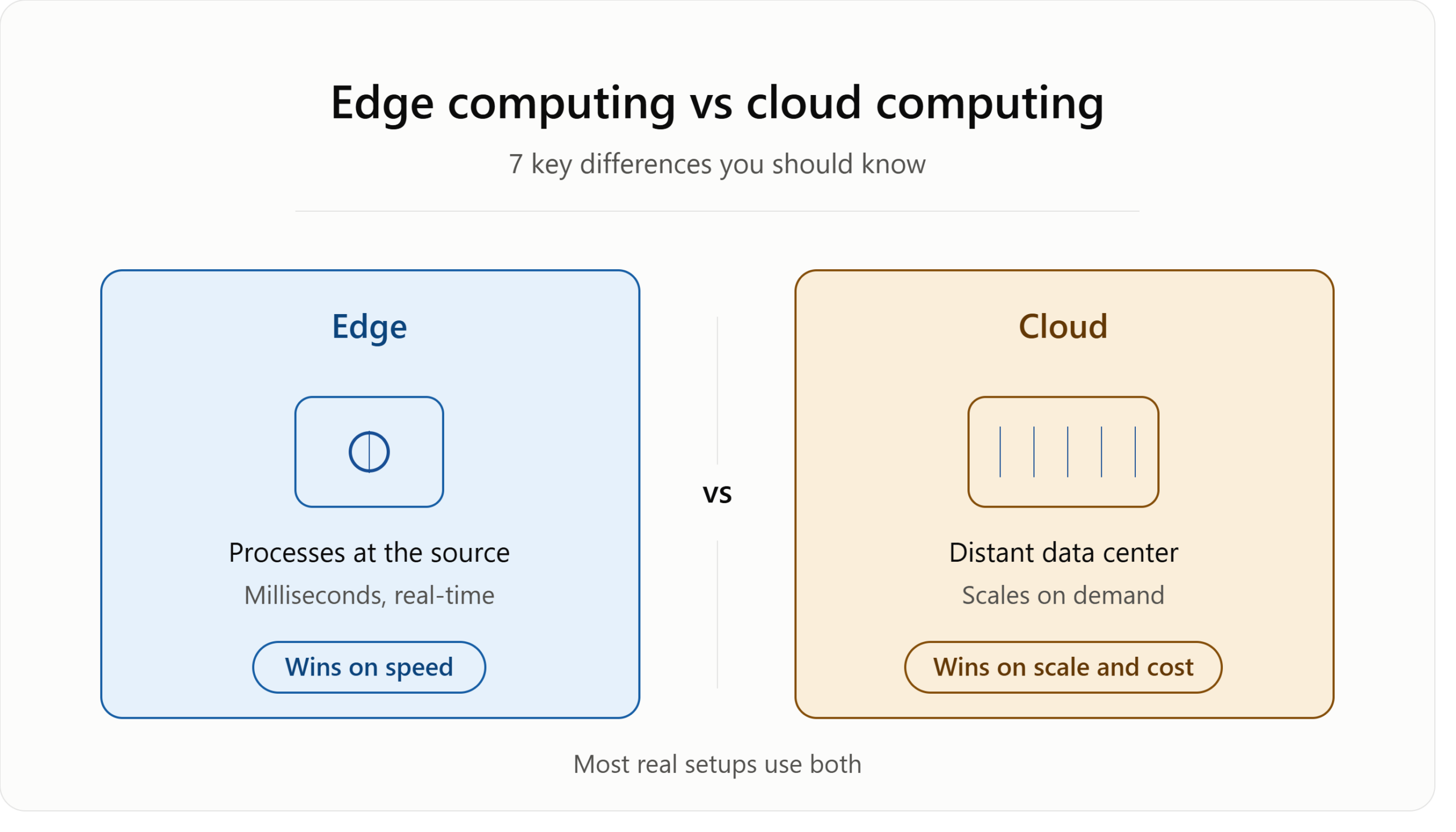
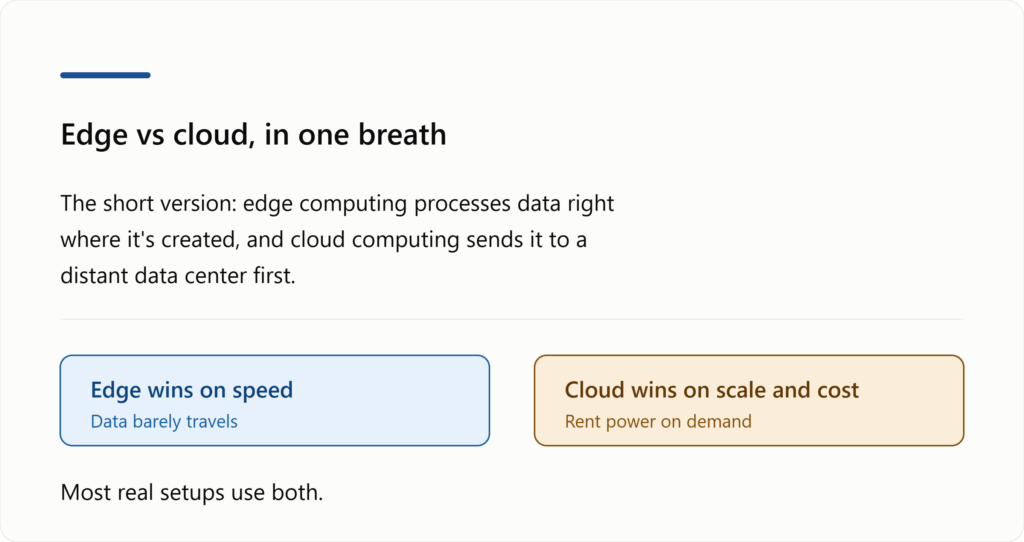
The short version: edge computing processes data right where it’s created, and cloud computing sends it to a distant data center first. Edge wins on speed. Cloud wins on scale and cost. Most real setups use both.
What’s the main difference between edge and cloud computing?
Location. That’s it at the core.
Cloud computing runs your data through remote servers owned by providers like AWS, Azure, or Google Cloud. Your device sends data over the internet, the server does the work, and the answer comes back. Edge computing does the work locally, on the device or on a small server sitting a few feet away, so the data barely travels at all.
A quick way to picture it: a security camera that streams every frame to the cloud for analysis is cloud computing. A camera with a chip inside that recognizes a face on the spot is edge computing. Same job, two very different paths.
Edge computing vs cloud computing: the 7 differences at a glance
| Factor | Edge Computing | Cloud Computing |
|---|---|---|
| Where processing happens | On or near the device | Remote data centers |
| Latency | Milliseconds, near real-time | Higher, depends on connection |
| Bandwidth used | Low, sends only key data | High, sends most data upstream |
| Upfront cost | Higher (buy hardware) | Lower (pay as you go) |
| Scalability | Capped by local hardware | Scales on demand |
| Security angle | Data stays local, more devices to guard | Central protection, data moves in transit |
| Best fit | Real-time, IoT, remote sites | Storage, big data, AI training |
Now the detail behind each one.
1. Where does the processing actually happen?
Cloud centralizes. Edge distributes.
With cloud, your data might travel hundreds or thousands of miles to a data center before anything happens to it. With edge, the compute sits next to the source. For a factory floor with 200 sensors, that means a small gateway on-site handles the readings instead of shipping all of them to a server across the country.
2. How much does latency differ?
Enough to matter for anything real-time.
Latency is the lag between asking and answering. Edge keeps it in the low-millisecond range because the data isn’t going anywhere far. Cloud adds the round-trip time to and from the data center, plus whatever your internet connection is doing that second.
For streaming a movie, nobody notices. For a self-driving car deciding whether to brake, that lag is the whole ballgame. [PLACEHOLDER: add a specific latency figure from your own test or a cited benchmark, e.g. “In our test, edge processing returned results in X ms vs Y ms for cloud.”]
3. Which one uses more bandwidth?
Cloud, by a wide margin, once you scale up devices.
Picture 1,000 IoT sensors each sending raw data around the clock. Push all of that to the cloud and your bandwidth bill climbs fast, and the network clogs. Edge processes the data locally and forwards only what matters: a summary, an alert, a flagged event. Less traffic, lower cost, less congestion.
4. What’s the real cost difference?
Cloud is cheaper to start. Edge can be cheaper to run at scale.
Cloud has almost no upfront cost. You rent compute and storage and pay for what you use. Edge makes you buy and install hardware first, so the initial bill is higher. The trade shows up later: at large scale, edge cuts your bandwidth and cloud-processing fees, which can pay back that hardware over time. [PLACEHOLDER: drop in your own cost breakdown or a client’s before/after numbers here, this is the part competitors can’t copy.]
5. Which scales more easily?
Cloud, without much contest.
Need more power in the cloud? You provision it in minutes and pay a bit more. Edge scaling means physically adding or upgrading hardware at each site, which takes money, time, and someone on the ground. If your workload spikes unpredictably, cloud handles it far more gracefully.
6. Which is more secure?
Neither, flatly. They protect you in different ways and expose you in different ways.
Edge keeps sensitive data local, so it never crosses the open internet. That helps with privacy rules like GDPR and shrinks the chance of interception in transit. The catch: every edge device is a physical box someone could tamper with, and more boxes means more things to patch and lock down.
Cloud providers pour serious money into central security, encryption, monitoring, and compliance certifications most companies can’t match on their own. But your data has to travel to reach them, and that transit is the exposed stretch. The honest answer is that a well-run hybrid setup often handles security best.
7. What is each one actually best for?
They solve different problems, so match the tool to the job.
Edge fits real-time and remote work: autonomous vehicles, smart factories, patient monitoring in hospitals, AR and VR, and any site with weak or unreliable connectivity. Cloud fits heavy lifting that can wait a beat: large-scale storage, big-data analytics, and training machine-learning models where you need a lot of compute in one place.
Do you have to choose between edge and cloud?
No, and most companies don’t.
The two work together more often than they compete. A typical hybrid pattern: edge handles the time-sensitive processing on-site, then passes cleaned-up, aggregated data to the cloud for storage, deep analysis, and AI training.
Your smart camera catches motion at the edge instantly, then stores the footage and runs heavier analytics in the cloud. Fast where you need fast, scalable where you need scale.
How do you decide which one you need?
Run through these five questions:
- Do you need answers in real time? Lean edge.
- Are you crunching huge datasets or training AI models? Lean cloud.
- Is bandwidth expensive or your connection unreliable? Lean edge.
- Do you want low upfront cost and easy scaling? Lean cloud.
- Do you have strict privacy or compliance rules? A hybrid edge-cloud setup usually fits best.
If your answers split across both columns, that’s not a problem. It’s the signal that a hybrid design is the right call.
FAQ
Is edge computing replacing cloud computing? No. Edge handles the jobs cloud is too slow or too bandwidth-heavy for. Cloud still owns storage, large-scale analytics, and AI training. They’re built to run together.
Is edge computing more expensive than cloud? Usually more upfront, because you buy hardware. It can cost less over time at scale by cutting bandwidth and cloud-processing fees. The break-even point depends on how many devices you run and how much data they push.
Can you use edge and cloud at the same time? Yes, and it’s the most common real-world setup. Edge does immediate processing on-site; cloud handles storage and heavier analysis afterward.
What are examples of edge computing? Self-driving cars, smart security cameras, factory sensors, wearable health monitors, and cashier-less stores. Anything that needs a decision in milliseconds without waiting on a distant server.
Which is better for a small business? For most small businesses, cloud is the practical starting point: low upfront cost, no hardware to manage, easy to scale. Add edge only when you hit a real need for real-time processing or you’re paying too much for bandwidth. [PLACEHOLDER: your own recommendation or a client example fits well here.]
Your next step
Take one workload you’re running right now and answer the five questions above for it. If it lands mostly in the edge column, price out a small edge gateway for that single use case before you commit to anything bigger. If it lands in the cloud column, you’re likely already in the right place. Start with one workload, not your whole stack.

Write For Us Technology is a trusted platform for sharing expert-driven insights on modern technology, digital marketing, and emerging innovations. Our editorial team includes SEO professionals, developers, and tech writers who actively work in the industry and bring practical, real-world experience to every article.