



Seekde is an AI-powered knowledge discovery platform that searches multiple sources at once, summarizes the findings with citations, and maps how ideas connect using visual knowledge graphs. Instead of handing you a list of blue links, Seekde aims to hand you understanding. If a normal search engine gives you the raw ingredients, Seekde tries to give you the finished meal with the recipe card attached. This guide explains what Seekde actually is, how it works, where it genuinely helps, and the honest limitations you should weigh before you rely on it.
What Is Seekde, Exactly?
Seekde positions itself as a “next-generation knowledge platform” rather than a search engine. The difference matters. A search engine is optimized to find pages. Seekde is built to assemble answers, show the reasoning behind them, and reveal how individual facts relate to a bigger picture.
The platform rests on three ideas working together: it reads the intent behind your query, it learns from how you use it, and it visualizes the relationships between concepts. The goal is a guided journey through a topic instead of a pile of tabs you have to sort yourself.
One honest note that most write-ups skip: Seekde is early-stage, and the name currently appears across several different websites and explainer pages rather than one dominant, household-name product. Treat it as an emerging category and a promising platform, not a finished giant like Google. That framing will save you disappointment and help you evaluate it fairly.
Why Seekde Exists: The Information Overload Problem
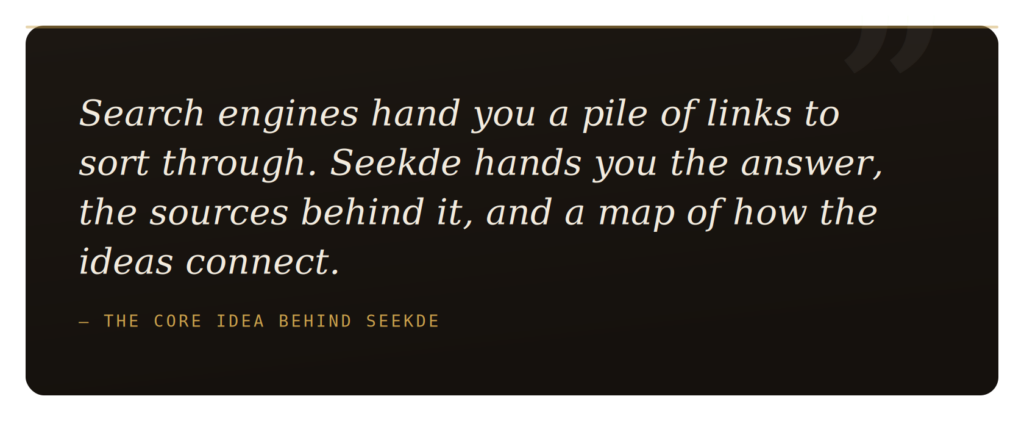
Seekde is a response to a measurable, expensive problem: we drown in information but starve for clarity. The numbers behind “search fatigue” are striking.
According to McKinsey’s widely cited research, employees spend roughly 1.8 hours every day, about 9.3 hours a week, simply searching for and gathering information. That is nearly one full day per working week lost to hunting rather than doing. Put another way, a five-person team effectively shows up as four, because the fifth is always off looking for something.
The International Data Corporation (IDC) found that around 26% of a knowledge worker’s day goes to finding and consolidating information scattered across systems, and that workers locate what they actually need only about 56% of the time. A SearchYourCloud study reported that people often run up to eight separate searches before landing on the right document. The marketing firm Interact pegged the waste at 19.8% of all business time, the equivalent of one day per week.
Layer the AI era on top of this. AI-generated summaries now appear in roughly half of all Google searches, a share many analysts expect to exceed 75% by 2028. Roughly 60% of Americans already use generative AI for search at least occasionally, rising to about 74% among adults under 30. Yet AI chatbots carry their own flaw: they can produce confident answers without telling you where the information came from, which is a problem when accuracy is non-negotiable.
By the Numbers: The Discovery Gap
| Statistic | Figure | Source |
|---|---|---|
| Time knowledge workers spend searching for information | ~1.8 hrs/day (9.3 hrs/week) | McKinsey |
| Knowledge worker’s day spent finding/consolidating info | ~26% | IDC |
| Of that time, how often they find what they need | ~56% | IDC |
| Business time wasted searching for information | 19.8% (1 day/week) | Interact |
| Searches needed to find the right document | Up to 8 | SearchYourCloud |
| Google searches that now include AI summaries | ~50% (projected 75%+ by 2028) | Industry estimates |
| Americans using generative AI for search | ~60% (74% under 30) | Industry estimates |
Seekde’s pitch lives in the gap these numbers describe: keyword search is fast but shallow, and AI chat is fluent but unsourced. The platform tries to occupy the middle ground of “fast, connected, and verifiable.”
How Seekde Works: The Three Pillars
Seekde describes its foundation as three capabilities that reinforce one another.
1. Search intelligence (understanding intent, not just keywords). Traditional search matches the words you typed. Seekde uses semantic understanding to interpret what you mean. Ask “best CRM for a solo agency with three clients” and the aim is a set of tradeoffs and next steps, not a generic list of CRM landing pages competing on SEO.
2. Adaptive learning (it improves the more you use it). Seekde tracks which summaries you find useful and which topics you return to, then tunes future results toward your style and goals. Over weeks, your research environment becomes personalized without you configuring anything.
3. Knowledge mapping (showing how ideas connect). This is Seekde’s signature feature. Instead of a linear list, it renders results as a knowledge graph: each concept is a node, and the lines between nodes show relationships. Search “climate change” and you might see policy, economics, climate science, and social impact tied together visually, so you grasp the structure of the topic, not just isolated facts.
Two plain-English definitions help here. Semantic search means the system matches meaning rather than exact words, so “heart attack” and “myocardial infarction” are understood as the same idea. A knowledge graph is simply a web of facts connected by labeled relationships, the same underlying technique that powers the info panels you see beside Google results.
Seekde in Action: Three Worked Examples
Abstract descriptions only go so far. Here is what intent-driven discovery looks like in practice.
Example 1: The graduate student. A behavioral economics student searches “how loss aversion influences financial decision-making.” A keyword engine returns 20 articles to read in sequence. Seekde’s approach is to surface a cited summary of the core concept, then draw a map linking loss aversion to nudging, prospect theory, and risk behavior, so the student sees which arguments are well-supported and where the literature is thin. Source-collection that once took weeks compresses into days.
Example 2: The market analyst. An analyst researching electric-vehicle adoption needs industry reports, academic studies, and internal team memos. Rather than switching between five tools, the analyst connects those sources to one platform, runs a single query, and receives an organized result set with citations pointing back to each origin. Set a topic alert, and weekly updates arrive automatically.
Example 3: The self-taught learner. A software engineer teaching herself machine learning asks how neural networks, natural language processing, and data ethics fit together. The knowledge graph shows the connections at a glance, and adaptive recommendations nudge her toward the gaps in her own exploration history. Curiosity becomes a structured learning path instead of a random walk through tutorials.
The thread in all three: the value is not the answer alone, it is the connected, sourced context around the answer.
Seekde vs Google vs ChatGPT vs Perplexity
People naturally compare Seekde with the tools they already use. Each was built to solve a different part of the discovery problem, so the honest takeaway is that they overlap rather than directly replace one another. Here is how the core capabilities line up.
| Capability | Seekde | ChatGPT | Perplexity | |
|---|---|---|---|---|
| Primary job | Connected knowledge discovery | Indexing and ranking pages | Conversational answers | AI answers with sources |
| Understands intent vs keywords | Yes | Partial | Yes | Yes |
| Cited, source-backed summaries | Yes | Partial (AI Overviews) | No (by default) | Yes |
| Visual knowledge graphs | Yes | No | No | No |
| Connect private docs (Drive, Notion) | Yes (stated) | No | Limited | Limited |
| Adaptive personalization | Yes | Limited | Limited | Limited |
| Team collaboration on research | Yes (stated) | No | No | No |
| Maturity and track record | Early-stage | Established | Established | Established |
Seekde’s differentiator is the combination: cited summaries plus visual concept mapping plus private-source integration in one place. Its weakness is maturity. Google, ChatGPT, and Perplexity are battle-tested at massive scale; Seekde is still proving itself.
Who Should Use Seekde?
Seekde is built for people whose work is research-heavy and whose value depends on connecting information accurately.
Students and academic researchers benefit most from the citation trail and the literature maps that reveal gaps in a field. Business analysts and consultants gain from unified search across reports and internal documents, plus automated alerts that replace manual trend-tracking. Research and content teams can build shared knowledge bases and keep everyone aligned. And lifelong learners who read across disciplines get the cross-domain connections drawn for them rather than having to assemble the threads by hand.
If your searches are simple and transactional, like checking the weather or a sports score, a traditional engine is faster and Seekde is overkill. The platform earns its keep on complex, multi-source, multi-step questions.
The Honest Limitations You Should Know
A credible review names the downsides, not just the upside.
Early-stage maturity. Seekde is new, and some capabilities shown in demos may not be fully available to every user. For high-stakes work, verify AI summaries against the original sources rather than trusting them outright.
Risk of over-personalization. Adaptive learning is convenient, but it can quietly narrow what you see. If the system learns you favor one viewpoint, it may downrank contradicting evidence. Deliberately seeking opposing perspectives counters this.
Privacy considerations. Connecting private documents means indexing potentially sensitive material. Review the platform’s data policies and permission controls carefully before linking internal files, especially in an organization.
Pricing clarity. At the time of writing, full pricing for premium and enterprise tiers is not comprehensively published across Seekde’s pages. Confirm current plans and costs directly before building workflows around paid features.
Should You Try Seekde? A Quick Decision Guide
Use this short framework to decide.
Try Seekde if you regularly research complex topics, juggle multiple sources, need citations you can verify, and value seeing how ideas connect. Start by creating an account, testing it on a subject you already know well (so you can judge accuracy), connecting just one external source, and using specific detailed queries instead of broad keywords.
Skip it, for now, if you only need quick factual lookups, you handle highly sensitive data without time to vet a new vendor’s privacy terms, or you require a mature platform with a long track record for mission-critical work. In those cases, established tools remain the safer bet until Seekde matures.
Final Thoughts
Research has always been about making connections, and finding a source is only the first step. The real work is understanding how that source fits the larger picture. Seekde is one of the more interesting attempts to handle both halves of that job at once, pairing cited AI summaries with visual knowledge maps in a single workspace. It is not a finished product, and trust in any AI-assisted tool should be earned through verification rather than assumed. But the problem Seekde targets is real, expensive, and growing, which is exactly why the platform is worth a careful test. Start with a topic you know, see how well it connects the dots, and let the results decide whether Seekde belongs in your workflow.
Frequently Asked Questions
1. What is Seekde in simple terms?
2. Is Seekde a search engine like Google?
3. How is Seekde different from ChatGPT?
4. How is Seekde different from Perplexity?
5. Who should use Seekde?
6. Is Seekde reliable for academic research?
7. Can Seekde connect to my private files like Google Drive or Notion?
8. What are the privacy risks of using Seekde?
9. Is Seekde free?
10. What is a knowledge graph in Seekde?

Write For Us Technology is a trusted platform for sharing expert-driven insights on modern technology, digital marketing, and emerging innovations. Our editorial team includes SEO professionals, developers, and tech writers who actively work in the industry and bring practical, real-world experience to every article.