


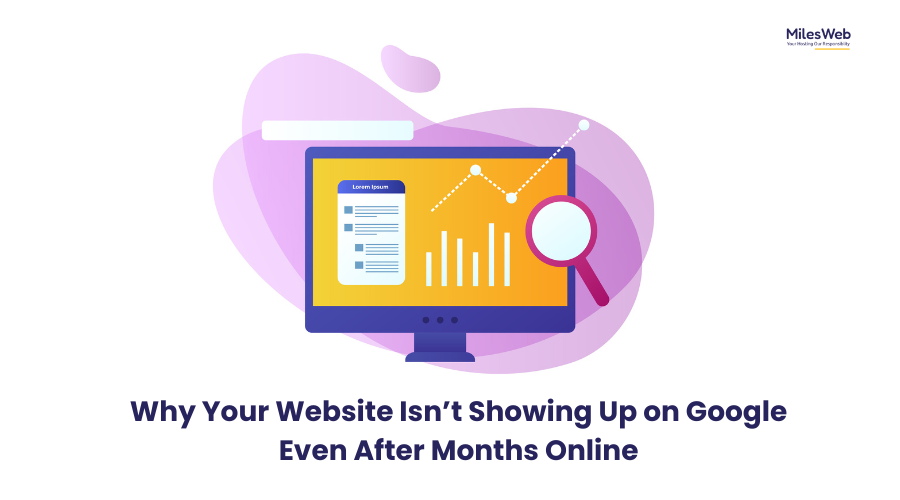
When launching a new platform, people expect Google to eventually pick it up and begin displaying it in its searches. Unfortunately, website owners with cheap SSD hosting in India go through an extended period of time sometimes several months where their online presence is completely invisible on Google.
While this can sometimes be due to technical failures, there are other issues like SEO, content, and website structure that prevent websites from ranking.
This blog will give you a list of the most common and neglected reasons that create a blog’s invisibility in Google.
Index Failures of Your Website by Google
The first common misconception is “Google automatically knows about every newly created webpage or website.” In fact, Google first has to find your new website; once discovered, the search engine then indexes it. When you search for MilesWeb, it also shows alternatives to GoDaddy, meaning related pages are discovered and indexed.
If you don’t submit your website to Google Search Console or don’t have any external or internal links pointing to your domain, the engine’s crawlers time to find and index your content. Therefore, you can expect several weeks before your new website starts showing up in Google’s search results.
Websites that don’t have an XML sitemap or have incorrect settings in their robots.txt file often remain undiscovered by Google. Even blocking just one line on your robots.txt file can prevent your entire website from appearing in Google’s search results.
Your Website Lacks Search Intent-Focused Content
If you’ve been online for months, it doesn’t mean your pages will be ranked high because you have the right content. Many brands fail because they produce content that is generic and unrelated to people’s queries.
When you publish pages that don’t answer a question, address a specific issue, or include any of the keyword phrases that users are searching for, Google won’t have a strong reason to rank those pages.
The same holds for pages that consist of poor or duplicate content. Pages written for only branding purposes struggle to get ranked by Google. Google’s principles are to rank websites on usefulness, relevance, and clarity, not just the presence of content.
Your Poor On-Page SEO Will Hold You Back
Website owners underestimate how severely their failed on-page SEO can adversely affect their rankings. Without a strong on-page framework, even outstanding content can go unnoticed.
A page that lacks (or has poorly constructed) title tags, meta descriptions, and headings confuses search engines when it comes to understanding what your page is about.
If multiple pages target the same keyword phrase or if none of them clearly express one topic, Google doesn’t know which of those pages deserves a higher ranking. Similarly, the absence of internal links reduces crawl efficiency and gives Google fewer signals on your webpage’s importance.
Your Website Has Technical SEO Problems
Your website might look perfect to visitors, but technical “invisible” glitches can still block Google from seeing every page. If Google can’t index your site completely, your rankings will drop—even if you don’t see any errors on the screen. The technical issues include slow load times, broken pages, mobile usability problems, or incorrect canonical tags.
If your website is not mobile-friendly, it will get decreased visibility by Google. Similarly, if JavaScript is used extensively without rendering support, Google can’t access the content on the web page properly. Even though a web page appears functional to a user, it may not be accessible to Google.
No Backlinks or Online Trust Signals
Google relies on trust signals for its search ranking algorithm, and backlinks are one of the strongest trust signals. When there are no backlinks to your website, it is classified as an isolated website by Google.
New websites are at a greater disadvantage when there are no mentions, directory listings, citations, or references from other websites, and have limited backlinks. Even a perfectly optimized site won’t rank high without “votes of confidence” from others. Without backlinks, Google won’t verify the value or credibility of your website.
Your Website Is Competing in an Overcrowded Space
In some cases, ranking issues aren’t due to the website; it’s because your competitors are simply doing better. When older, authoritative websites within an industry use the same competitive keywords, it may take much longer for your brand-new website to achieve a high-ranking position. Competing against established, high-authority domains for search engine rankings takes time and requires patience.
Brand-new websites trying to compete for competitive keywords won’t rank on page one of Google’s SERPs. Google favors well-established domains with a great amount of content depth and strong backlink profiles that execute a concentrated or long-tail keyword strategy. Without either of these strategies, achieving visibility for your website is extremely difficult.
Inconsistent Updates and Lack of Content Growth
If your website is stagnant (i.e., doesn’t have new pages, content updates, or improved content for viewing on Google) for months at a time, the weak engagement signals sent to Google hurt your current and future SERPs.
Search engines reward creators that continuously update new content, provide consistent value, and improve their websites’ usability over time.
If you are taking a “launch and forget” approach to the development of your website, you will experience low visibility, and it may take you months of hard work to achieve a top position from which you can drive traffic to your website.
Google Trust Takes Time, Signals Speed It Up
While trust takes time to build with a search engine like Google, it is being built by providing Google with consistent engagement signals, including quality content creation frequently, interaction with site users, website UI, and the factors of your website in general.
Final Considerations
If your site is still invisible on Google after several months, it isn’t just bad luck. There is likely a specific technical or strategic reason holding you back. Most often, it results from a number of factors combined: excessive gaps in indexing, the absence of quality SEO, insufficient trust signals, or a lack of coherence between the content of the website and the user’s search intent.
It takes effort to get visibility in Google. Once established through quality, reliability, and trustworthiness, you can generally expect to see an increase in search visibility once these qualities are established.